Karma yoga & Jñāna Yoga
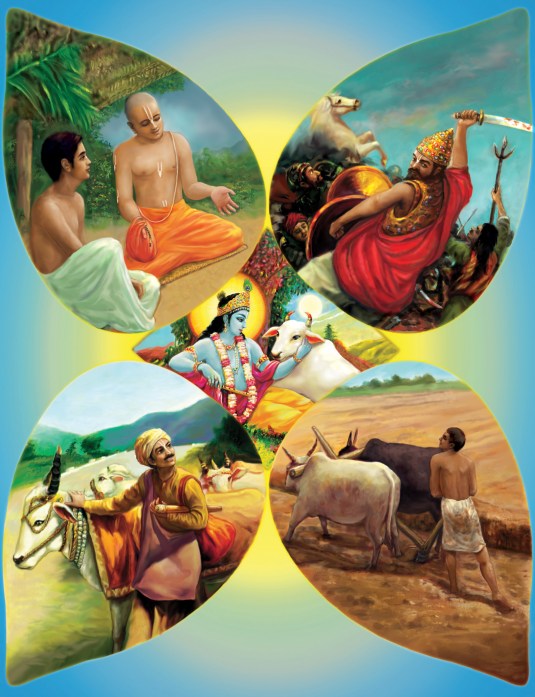
Nitya-karmas include, for example, for the upper three varṇas (brāhmaṇa, kṣatriya, and vaiśya), performing sandhyā-vandana, pañca-mahā-yajña, and other daily rituals. Naimittika-karmas include duties performed periodically, such as the śrāddha ceremony. Along with these, a person—if he is a gṛhastha—also performs his occupation (see Srīmad-bhāgavatam 7.11.14 onwards) according to his varṇa.
The person should offer all these activities to the Lord at the end of each day and continue to worship the Lord daily. The details of these duties are described in Śrīmad-Bhāgavatam, especially in the last five chapters of the Seventh Canto.
When performing these activities, one may do so either with desire or without desire. “With desire” means having a desire for the results of the individual actions as well as for the ultimate result of karma-yoga. That is, if a person performs karma-yoga properly, even with desire, he attains svarga-loka after death. Desiring svarga-loka, such a person may practice karma-yoga. This is called sakāma karma-yoga. Sometimes this is mistakenly referred to as karma-kāṇḍa, but in truth, karma-kāṇḍa refers to that section of the scriptures which describe the various karmas to be performed (The other two sections of the scriptures are jñāna-kāṇḍa and upāsanā-kāṇḍa.)
If the same karma-yoga is performed without desire for the results of the actions (such as those glorified in phala-śruti statements like “performing the cāturmāsya sacrifice grants inexhaustible merit”) and without desire for svarga-loka at the end of life, then the person’s heart becomes purified. Such a person realizes, after a long time, a reflection (ābhāsa) of his own ātmā by performing this karma-yoga without desire, but offered to the Lord, and thus becomes eligible to practice jñāna-yoga.

At any time, those practicing these paths can take up bhakti-yoga and attain prema (love of Godhead) for the Lord, thus attaining His abode as His eternal associate.
However, in all these yogas (karma, jñāna, and aṣṭāṅga), one must perform bhakti to Lord Viṣṇu, for without devotion, none of these paths bear fruit.
The person who has many desires should perform karma-yoga. If possible, he should practice niṣkāma karma-yoga; if that is not possible, he should at least perform sakāma karma-yoga. The person whose heart has been purified and whose senses are under control through prolonged performance of niṣkāma karma-yoga, accompanied by worship of the Lord, should then proceed to the practice of jñāna-yoga.
Side note: Sometimes, this technical term jñāna is mistakenly taken to mean general “knowledge,” either as mundane, bookish knowledge or, worse, as knowledge of bhakti scriptures. In the practice of pure bhakti, when it is said that jñāna should be avoided, it refers specifically to this technical jñāna—particularly the conception of the oneness of ātmā and Brahman—and it never refers to knowledge of bhakti scriptures. In fact, scriptural knowledge related to bhakti is essential for practicing bhakti.
Aṣṭāṅga-Yoga

Yama refers to following principles such as non-violence, truthfulness, not stealing, and not accepting more than necessary. Niyama includes study of the scriptures, worship of the Supreme Lord, and performing one’s own svadharma.
Along with these, one also practices āsana, prāṇāyāma, pratyāhāra, and dhāraṇā.
Since the practitioner must sit for long periods of meditation (gradually increasing the duration), he practices āsanas—different yogic postures (widely known today as yoga)—to minimize bodily disturbances during meditation. He performs prāṇāyāma, or breathing exercises, to pacify the mind. He also practices pratyāhāra, withdrawing his consciousness from attachment to sense objects while engaging with them.
Then, during dhāraṇā (concentration), he focuses his mind on the Supreme Lord and His pastimes. Through further intensification of these practices, he enters dhyāna (continuous meditation) and ultimately samādhi (complete absorption, the final attainment of the result).
A person following this path generally attains realization of the Paramātmā. This process is described in detail in the twenty-eighth chapter of the Third Canto and the first two chapters of the Second Canto of Śrīmad-Bhāgavatam.
Bhakti-Yoga

Bhakti-yoga begins with śraddhā, or faith. This faith means confidence in the process of bhakti—that it alone bestows the supreme and ultimate goal (puruṣārtha)—and faith in the bhakti scriptures and in the existence of the Lord, accepting oneself as His servant.
Although this faith may be weak at first, the practitioner associates with devotees (bhaktas), and inspired by them—or by one devotee who becomes his guru—he begins performing devotional service such as hearing (śravaṇam), chanting (kīrtanam), and remembering (smaraṇam) the Lord’s names, forms, and pastimes.
Sometimes the word “service” (sevā) is misunderstood to mean only physical or missionary service such as cleaning the temple, distributing books, or preaching. But sevā (service) in bhakti refers to any activity performed for the pleasure of the Lord and His devotees—whether chanting His holy names, reading and remembering His pastimes, or engaging in activities like preaching and book distribution (the last two are subcategories of kīrtanam). For further details on this specific aside topic, refer to my article.
The nine primary forms of sevā in bhakti are: Hearing (śravaṇam), Chanting (kīrtanam), Remembering (smaraṇam), Serving the Deity (pāda-sevanam, arcanam, vandanam), Serving the Lord as master (dāsyam), Befriending Him (sakhyam), and Offering everything one possesses, including oneself, to the Lord (ātma-nivedanam). The last two are rarely practiced in the sādhana stage.
By performing these activities, the devotee gradually removes all anarthas (unwanted desires) from the heart, attains steadiness in practice (niṣṭhā), and continues to advance step by step until he achieves direct vision of the Lord (sākṣātkāra). Afterward, he gives up his material body and attains a spiritual body, becoming an associate of the Lord in the spiritual world.
The person who possesses faith in bhakti as described above is qualified to practice bhakti-yoga.
The Yoga Ladder

The ladder here does not represent the gradual elevation of a practitioner through successive yogas sequentially mentioned here, but rather a hierarchy based on the final realization or result of each path. It is not that one must first perform karma-yoga, then jñāna-yoga, then aṣṭāṅga-yoga, and finally bhakti-yoga.
A person may directly perform karma-yoga or directly take up bhakti-yoga. One may, however, progress from karma-yoga to jñāna-yoga. Or, while performing his own svadharma, he may begin aṣṭāṅga-yoga—this stage is called yogārurukṣu (one desiring to ascend the path of yoga), since performing svadharma is part of niyama as mentioned the section of aṣṭāṅga-yoga.
Direct practice of jñāna-yoga requires prior purification through karma-yoga. But from karma-yoga, jñāna-yoga, aṣṭāṅga-yoga, or even from a sinful life (without practicing any of these yogas), a person can directly take up bhakti-yoga, abandoning his previous path or lifestyle altogether.
Thus, the ladder does not represent the progression of a practitioner through various yogas sequentially; rather it illustrates the hierarchy of the final results attained through them:
- The result of karma-yoga is either svarga-loka (for sakāma karma-yoga) or purification of the heart (for niṣkāma karma-yoga).
- The result of jñāna-yoga is impersonal liberation (Brahman realization).
- The result of aṣṭāṅga-yoga is realization of the Paramātmā.
- The result of bhakti-yoga is realization of Bhagavān.
Bhagavān realization is superior to Paramātmā realization; Paramātmā realization is superior to impersonal liberation; and impersonal liberation is superior to both svarga-loka and mere purification of the heart. Thus, the “yoga ladder” is a ladder of hierarchy in the results of the various paths—not a sequence of stages one must climb through. Please take a look at the picture.
I have mainly avoided giving references fearing the length of this article. Thank you.
A very nice and comprehensive explanations of the yoga systems.
ReplyDeleteThank you. Glad you liked it.
DeleteVery nicely written article summarizing the different yoga systems prabhu 🙏. It’s quite interesting to see the connection behind jñāna and aṣṭāṅga yoga paths to brahman and paramātmā realizations. Keep up the wonderful service, Hare Kṛṣṇa!
ReplyDeleteThank you prabhu.
DeleteVery nice article Prabhu, I enjoyed reading it. A times, we hear these different yoga terms loosely used, so the explanations here are very helpful to understand what they mean, what they lead to and especially how bhakti yoga is a process that can be picked up from anywhere one is. Haribol!
ReplyDeleteThank you for this insightful article Prabhu. It really gave me a clear idea on the types of yoga. _/\_
ReplyDelete